Willie
Black BeautyWillie is Mr. Thoroughgood’s grandson and the young advocate whose attention helps save Black Beauty from being discarded after years of hard work. At the horse sale, he looks past Black Beauty’s thin condition to the signs of a once-fine horse; after his grandfather buys him, Willie accepts responsibility for his daily care. His part in the story is small in scale but decisive in effect: he notices, persuades, and then follows through with patient kindness.
At the Horse Sale
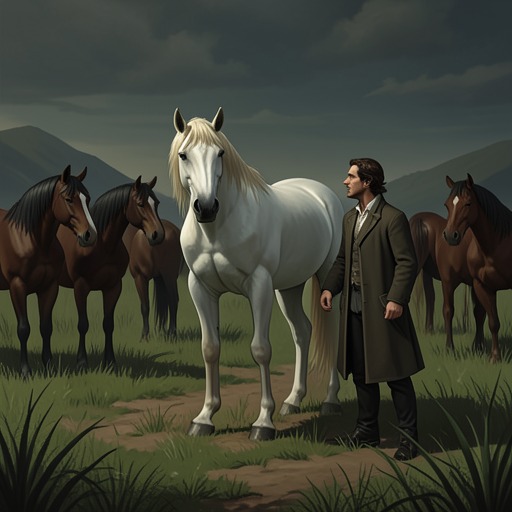
Willie appears beside his grandfather among the horses offered for sale. Black Beauty is in the company of worn and ailing animals, but the boy does not judge him by his present condition alone. He asks whether the horse might once have been a carriage horse, and Mr. Thoroughgood agrees that Black Beauty could have been many things when young, pointing to the shape of his nostrils, ears, neck, and shoulder as signs of breeding. Willie strokes the horse’s face, and Black Beauty responds by putting his nose toward him. The exchange gives the boy a concrete reason to believe that the horse still understands and welcomes gentleness.
Willie then presses his grandfather to look more carefully before deciding that Black Beauty is old. He points to the horse’s mane and tail and asks Mr. Thoroughgood to inspect his mouth, reasoning that this could help establish his age. His attention is both affectionate and observant: he reads the horse’s appearance as evidence, not merely as a prompt for pity. When he asks whether Black Beauty could be made young again as Ladybird had been, his grandfather explains that Ladybird was not very old but had been run down and badly treated. Willie’s hope thus meets a practical qualification, but it does not diminish his wish that Black Beauty be given a chance.
The seller adds that Black Beauty has been pulled down by overwork in cabs, is not old, and might recover with six months’ rest. Willie’s appeal aligns with this assessment: the horse may have a future if someone is willing to provide the conditions for recovery. His role is not to make the purchase himself, but to move his grandfather toward examining the evidence and asking the price. The old gentleman agrees to go ahead, and Willie’s delight makes clear how much the decision matters to him.
Responsibility for Black Beauty
Once Black Beauty reaches his new home, Mr. Thoroughgood gives Willie oversight of him. The instruction turns the boy’s concern at the sale into an ongoing responsibility. Willie takes it seriously: he visits every day, sometimes finding Black Beauty among the other horses and bringing him a piece of carrot or another treat, and sometimes staying beside him while he eats his oats. He comes with kind words and caresses, making his attention a regular part of the horse’s new life rather than a single response to a distressing sight.
Black Beauty grows fond of Willie and comes to him in the field, following him about. Willie calls him Old Crony, a familiar name that reflects the easy companionship developing between them. The relationship is presented through repeated small acts: a visit, food offered by hand, and the horse choosing to approach and follow the boy. Willie does not simply sympathize with Black Beauty from a distance; the trust between them develops through the time he spends with him.
Willie also shares in watching the recovery. His grandfather looks closely at Black Beauty’s legs, identifying them as the concern to monitor, and tells Willie that the horse is improving steadily. The care described at the new home includes hay and oats morning and evening, access to the meadow during the day, rest, good food, soft turf, and gentle exercise. Willie’s daily visits accompany this practical regimen, while his grandfather assesses the horse’s physical progress. The story therefore connects the boy’s affection with the sustained provision Black Beauty needs to regain strength.
Recovery and the Next Home
During the winter, Black Beauty’s legs improve, and he begins to feel young again. In March, Mr. Thoroughgood tests him in the phaeton, taking Willie along for a drive of a few miles. Black Beauty is no longer stiff and manages the work with ease. The drive marks a change from the sale-yard judgment of a worn-out horse to a measured demonstration that rest and careful handling have restored some of his capacity. Willie is present for this trial and shares in the evidence of improvement.
Afterward, Mr. Thoroughgood says Black Beauty is growing young and proposes only gentle work, expecting him to be as good as Ladybird by midsummer. He praises the horse’s mouth and paces, while Willie responds with unrestrained happiness that his grandfather bought him. Mr. Thoroughgood answers that Black Beauty has more to thank Willie for than himself. This acknowledgment makes the boy’s influence explicit: the grandfather completed the purchase and arranged the care, but Willie’s insistence first turned the horse’s appearance at the sale into a possibility of rescue.
The recovery is not treated as the end of Black Beauty’s story. Mr. Thoroughgood and Willie intend to find him a quiet, genteel place where he will be valued. Willie’s part thus links the decision to save the horse with the hope of a safer working life: his attachment is not only a response to Black Beauty’s past condition, but part of the effort to secure a more considerate future.
Narrative Role
Willie’s brief appearance gives the sale scene its turning point. Other buyers and sellers are described in circumstances of poverty and hard times, but Willie’s attention focuses on what can still be discerned about an individual horse: his appearance, his responsiveness to kindness, and the possibility that his condition may be reversible. The narrative does not present the boy as able to restore Black Beauty by affection alone. Instead, his appeal prompts an adult with the means to act, and his continuing oversight accompanies the material care that makes recovery possible.
Because Black Beauty narrates his own life, Willie is encountered through the horse’s account of being noticed and treated kindly. His character is chiefly defined by that practical compassion: he examines before judging, urges his grandfather to buy, and then returns day after day to care for the horse. The movement from the crowded sale to the meadow and the March drive gives those actions their consequence. Willie helps turn a horse described as exhausted into one whose health improves and whose next home is to be chosen with his welfare in mind.